How to Search Grey Literature for a Systematic Review
Find relevant evidence outside conventional journal indexes without turning the search into an undocumented collection of web results.
What is grey literature?
Grey literature is research or evidence distributed outside conventional commercial and academic journal publishing. Depending on the review question, it can include government reports, policy papers, regulatory documents, clinical-study reports, theses, conference material, preprints, institutional reports, and repository records.
Where should you search?
Select sources from the protocol and review question. Do not treat a generic web search as a complete grey-literature strategy.
Government publications
Research reports, statistics, impact assessments, consultations, policy papers, and official evaluations.
Registries and regulators
Trial registrations, regulatory assessments, safety material, and study reports when applicable.
Repositories and preprints
Institutional repositories, open-research platforms, funder outputs, and disciplinary preprint servers.
Theses and conference material
Dissertations, proceedings, abstracts, and reports that may not have a journal version.
Grey literature search: step by step
- 1
Define eligible publication types
State which reports, jurisdictions, organizations, languages, dates, and document types are relevant before searching.
- 2
Choose sources deliberately
Match each source to the evidence types and geography in the protocol. Ask an information specialist to review high-stakes searches.
- 3
Adapt the query per source
Portal syntax, indexing, languages, and filters differ. Preserve the concepts, but validate how every source interprets Boolean operators and phrases.
- 4
Record the search while running it
Save the source, URL, complete query, filters, search date, result count, export method, and any screening limitations.
- 5
Combine, label, and deduplicate
Keep source provenance and literature type attached to each record, then remove duplicate citations before screening.
Minimum search log
| Field | Record | Why it matters |
|---|---|---|
| Source | Portal and direct URL | Makes the search repeatable |
| Query | Exact submitted string | Prevents undocumented rewriting |
| Limits | Date, language, type | Makes restrictions visible |
| Search run | Date and result count | Supports updates and reporting |
Search academic databases and government grey literature together
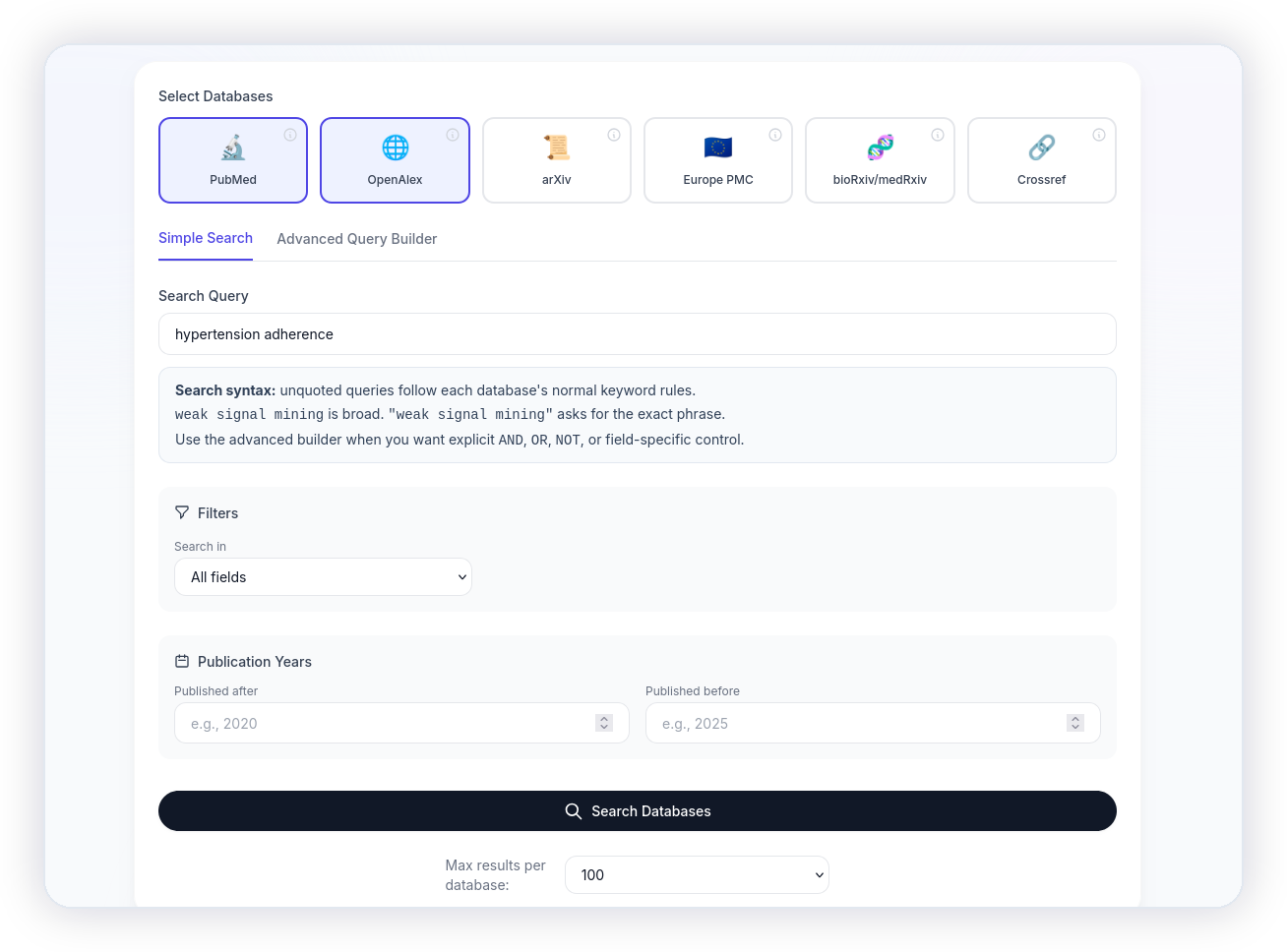
Lumina provides a supplementary search across scholarly sources and a bundled government-publications source. Government concepts can be expanded across English, Dutch, German, French, and Spanish for review before searching. Results retain source labels and move into the same deduplication and screening workflow.
This does not replace topic-specific databases, registries, regulatory sources, or an information specialist. Use it as a documented supplementary layer alongside the sources required by your protocol.
Explore multi-database and grey-literature search →