Title & Abstract Screening
Best practices for the most time-consuming phase of your systematic review — and how to do it faster without sacrificing quality.
What Is Title & Abstract Screening?
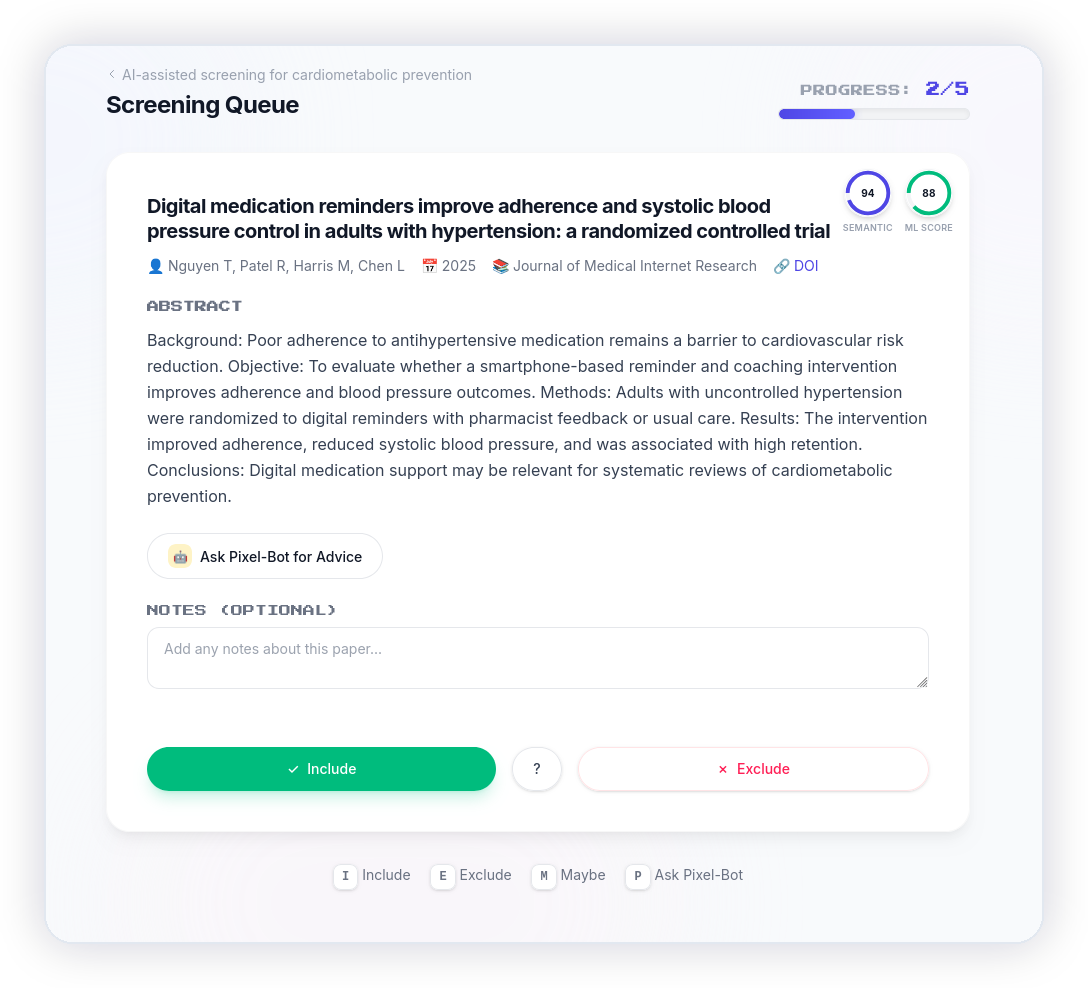
Title and abstract screening is the first filter in a systematic review. You read each paper's title and abstract and decide whether it could be relevant based on your inclusion criteria. Papers that pass move to full-text review.
🎯 Key Principle: At this stage, be liberal. When eligibility cannot be determined from the available title and abstract, retain the record for full-text assessment rather than guessing.
How to Screen Effectively
Pilot Test Your Criteria
Screen the same calibration sample as a team. Discuss disagreements and refine your criteria before starting the full screening.
Read Title First, Then Abstract
Many papers can be excluded on title alone (e.g. clearly wrong population or topic). Only read the abstract when the title is ambiguous.
Use a Three-Decision System
Include (clearly relevant), Exclude (clearly irrelevant), Maybe (needs discussion or full text). The "Maybe" category reduces premature exclusions.
Screen in Batches
Use manageable sessions and monitor consistency. Session length should reflect abstract complexity, reviewer experience, and fatigue.
Document Everything
Retain decision history and counts. At full-text screening, record one primary exclusion reason for each excluded report for your PRISMA flow diagram.
Single vs. Dual Screening
| Single Screening | Dual Screening | |
|---|---|---|
| How it works | One reviewer screens all papers | Two reviewers screen independently |
| Speed | Fast | Slower |
| Reliability | Lower | Higher |
| Best for | Rapid reviews, scoping reviews | Cochrane reviews, journal publications |
Read our detailed Dual Screening guide → | Cochrane study-selection guidance
Using AI to Prioritize the Queue
Active learning can surface likely-relevant records earlier. That changes screening order; it does not by itself justify excluding unscreened records or replacing an independent reviewer.
Likely matches appear earlier
Humans retain final decisions
Document tools and stopping rules
Looking for a product-focused overview? See Lumina's systematic review screening software workflow, including imports, reviewer decisions, dual review, conflicts, and exports.
Continue Learning
Screen Smarter, Not Harder
Lumina's AI prioritizes the most relevant papers first, so you find what matters without reading thousands of irrelevant abstracts.